 |

 Though the Conquistadors were far more excited about the gold, silver and jewels that formed the bulk of Monte-zuma’s magnificent gifts, both Cortez and Bernal Diaz del Castillo mentioned with admiration the artistry and beauty of the feather cloaks, shields, banners and head-dresses that were part of them. Later chroniclers like Fray Bernadino de Sahagun and Bishop Diego de Landa not only admired the unique art, but hastened to incorporate into the panoply of the church.
Fray Francisco Ajofrin visited Patzcuaro where “The Indians made those famous feather pictures without adding color or varnish... very beautiful in color and variety.” These, he noted, made use of the plumage of the tiny huitzlin (hummingbirds) which were so common to the area that the name of the capital city, Tzintzuntzan, translates as “Where the Hummingbirds Are.”
Sahagun also took note of the methods of construction and listed the tools, techniques and materials used. Copper scalpels and knives for cutting on a wooden block, bone blades for positioning and small pieces of red wood for holding in place, amate paper or cloth backings, maguey fiber cords for tying. These, plus glues made from the dried and powdered bulb of a terrestrial orchid, which is still used to make the macabre Halloween confections which so delight Mexican children, were all these artisans needed to create their masterpieces. The combs, tweezers and scissors introduced by the Spanish were welcome but not vital to their art.
Methods of construction varied. For mosaics, the feathers were glued onto to amate paper, wooden or cloth backing. For shields they were woven into light weight twig or reed frames and for cloaks they were interwoven into cloth as it came from the loom. The towering headdresses had their plumes laced into place with maguey fibers and some intricate pieces used several of these methods in combination.
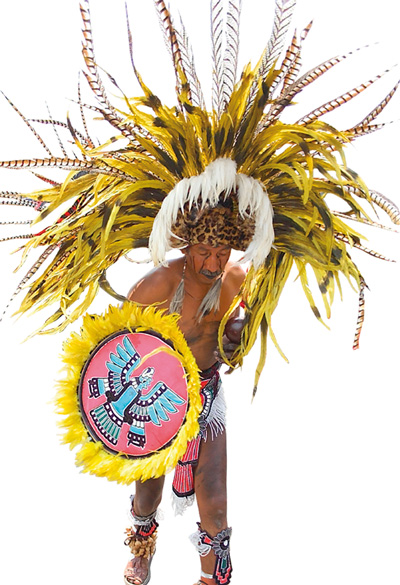
 It would seem that the ancients of this hemisphere literally worshipped feathers. From the early Maya to the ill-fated Aztecs, nobles, priests and warriors delighted in arraying themselves in cloaks, headdresses, ear spools, necklaces, bracelets and arm bands of brilliant feathers. Women wove bands of feathers into their clothing; warriors were awarded spears and shields decorated with them for bravery in battle; altars and temples were decorated with them; feathers in a dazzling rainbow of colors were everywhere.
The feathers they used came from all over the New World. Vivid blues came from the Xiuhtotl (Turquoise Bird), brilliant reds from the Pacific Parrot, the Roseate Spoonbill or the Scarlet Macaw. Whites came from the breasts of large geese from Perú and they could be dyed in those rare instances when Mother Nature failed to produce just the right hue. Shimmering iridescent greens came from the magnificent Quetzal, whose very name means “precious,” and its plumes, reserved for royalty, were so valued that killing one of the birds was punishable by death.
The Aztecs so delighted in feather ornaments and decorations that a sizeable portion of their tribute from subject territories was assessed in bundles, bales or bunches of feathers. For example, one of their tax rolls states that eight towns of the tropical region were to supply:
400 clusters of valuable blue feathers
800 clusters of valuable red feathers
400 bunches of valuable turquoise feathers
800 bunches of valuable red feathers
800 bundles of valuable long feathers, green
160 bird skins with valuable turquoise and purple breast feathers
Moctezuma possessed his own aviary of exotic species, so large that it required 300 attendants to care for the birds, and also maintained his own group of feather artists. His wives and concubines made his personal clothing which was worn only once and given away to those deserving of such great honor.
 Fortunately, many of the colonial feather mosaics, wall hangings, copes and miters have survived. They give us some idea of the wonder and beauty that is lost. What is tragic is that only eight of the countless pieces of pre-Columbian feather work are still in existence.
The piece known to us as Montezuma’s Headdress is the most striking as well as the most familiar. It is quite large, 166 cm. high and 177cm. wide (roughly 5’5" by 5’10") and is composed of 500 green-gold quetzal tail plumes and trimmed with white, blue and red feather bands and small gold rosettes. The original has had a wandering history, having lain, along with two other of those eight surviving works, for years in an old chest in the Tyrol where it had been inventoried as a “Moorish Hat.” It is now on view in Vienna but the Museum of Anthropology in Mexico City has an exact copy.
Considering the fragility of the piece and the many vicissitudes it has undergone, it is a wonder it still exists. Simply surviving the long sea voyage from the New World was no mean feat in the days of sail. Once there, it was worn by several generations of children for costume balls at the count of Tyrol’s court; it was taken apart and incorrectly reassembled several times by would-be restorers and one Archduke of Austria was painted wearing a panache of long green plumes while another even snitched a few plumes to decorate his horse’s helm.
The remaining seven pieces are scattered, five in European collections and three in Mexico. One is a shield with the snarling blue coyote outlined in narrow gold leaf strips on a background that was originally described as crimson but has faded to dusty pink over the years. Another is large circular fan or fly whisk with vivid blue feathers on the outside and inner circles of deep red and a chevron pattern in blues, yellows, greens, reds and browns has a smiling, multicolored butterfly as a central disk. Both pieces and 14 others were in the same chest in the Tyrol and are now in Vienna. Two other shields in very poor condition are in the State Museum of Wurttemberg in Stuttgart, Germany.
A feather work mantle, possibly among the very first gifts presented by Moctezuma to Cortez in 1519 and sent on to the Emperor Charles V, was for many years in Brussels, then in the Castle of Luxembourg. It is now back where it belongs, in The Museum of History in Mexico City. Another shield or disk, the only piece that managed to survive the depredations of time and the Conquistadors in its native land, was found in the State of Hidalgo along with a 16th century gold chalice. It is now in the Museum of Anthropology in Mexico City.