| Charreria |
by Mildred Boyd
 To foreigners, the word "macho" might have been coined solely to describe the Mexican male, and nothing in the world is more macho than the Mexican vaquero, or charro, and the contest of riding and roping skills known as the Charreria. The sport probably began soon after the Spanish imported the firstcattle herds as hacendados and their hired hands vied with one another, as they had done for centuries back in Spain, showing off their fanciest tricks during roundups.
There are several versions of the origins of Charreria as a competitive sport. One claims that it all started in Hidalgo when a Spanish picador brought down a bull by catching it by the tail and twisting to become the first coleadero (tail puller). Another maintains that it started in the Los Altos region of Jalisco. In any case, it seems that it all began after the land reforms had deprived the great landowners of their vast holdings and herds. Nostalgically, they began to meet and compete as before; only now as pure sport. The Asociación Nacional de Charros was founded in 1921 and their rodeos became such a true national sport that Charro Day, September 14th, is now a National holiday and charros are sung aboutin the Mexican National Anthem.
| La Cala de Caballo |
 This event is designed to judge how well the horse responds to his training in a standard series of movements. First he is ridden at full gallop to the center of the ring and brought to an abrupt hall before he rears, leaving his hind hoof prints in the soft soil. This is called "marking" or "putting his hoofs in." Next, he turns from side to side several times in a maneuver called "showing the flanks." Finally, he walks backward in a straight line to his point of entry before returning to the center of the ring to take his bow.
| Pialar |
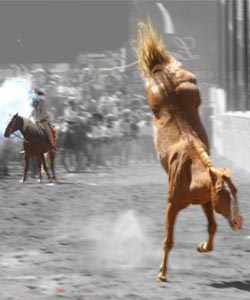 One of the most difficult things the charro has to perform, lassoing a running mare by the hind legs, has been criticized as cruelty. The object, however, is not to make the animal fall, but to slow her down until she stops by himself. Official competitions allow only one contestant or pialador but informal ones have three. The cowboy is allowed three tries and may move freely about the arena in search of the most advantageous spot. If the rope breaks, the attempt doesn’t count, but if the contestant lets the mare pull it out of his grasp, too bad!
 Rodeo goers will recognize this event as the bull riding contest. The rider mounts a young bull in the cajon (box) and, when it is released, tries to ride it to a standstill and dismount. This is no easy task. The infuriated bull immediately begins bucking and rearing in an attempt to rid himself of the unaccustomed weight. Since the rider has only a slender tope to hang on to and can do that with only one hand, all too often the bull succeeds. This is also a dangerous sport. A thrown rider is extremely vulnerable to being savaged by the angry bull unless it is immediately distracted.
| Terna |
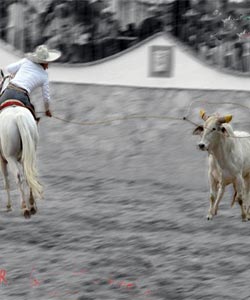 In the north, the bull is lured away by quick footed and quicker witted rodeo clowns. In the Charreria this is often accomplished by the terna, which is a separate contest. As the name implies, this involves three horsemen who, once the bull rider dismounts, willingly or not, start throwing their lassos. First they must get a tope over his horns, then lasso his feet, fell him and remove the topes to free him. All this, the ride, the roping and the release must take place within eight minutes from the second the bull leaves the cajon.
 In this sport modern charros try to emulate the feat of that legendary Spanish picador in Hidalgo. This involves catching the running bull by the tail and, by twisting it, bringing him down. Teams of three or five coleaderos are mounted and each man waiting for his three tries when the first wild bull is released. Each in turn salutes his bull and gives chase. Just behind and matching the animal’s pace, he reaches down and grabs the tail, tucking it firmly under his leg. He then spurs his horse to greater speed and, if all goes well, topples his bull. This must be accomplished within a designated area or it doesn’t count.
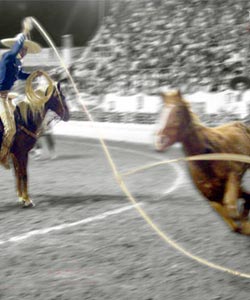 This is a contest of roping skills in which a charro must lasso the forelegs of a mare, either running or standing still, and in a certain order. He has three helpers who move the mare into an advantageous position. He may throw the tope from any position but must remain four meters of the barrier while his assistants try to run the mare through the space between. Three tries are allowed to lasso the mare in three different ways, but they must be done within eight minutes and the mangana is achieved only when he has roped one foreleg and then the other.
| El Paso de la Muerte |
 One of the most dangerous and exciting events in a Charreria, this one is aptly named The Death Pass. Here a rider on a lame horse must match the speed of a wild mare at full gallop then transfer from one horse’s back to the other with nothing to hold on to except the two manes. Then, of course, he must hang on for dear life while the startled mare bucks and rears until she comes to a standstill. Here again, he has three assistants and is allowed three attempts to accomplish this feat. If he misses the best opportunity as the mare leaves the gate, his assistants keep her circling the ring until she is in position for another try.
| La Escaramuza |
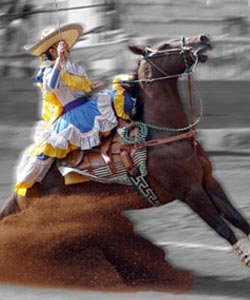 In 1953, women appeared for the first time in the arena at the Rancho del Charro in Mexico City. A group of charras, dressed in Adelita costume, performed an equestrian ballet to demonstrate their riding skills. The charm and grace of their performance was so well accepted that women have become an accepted part of the show in most areas. In fact, the Escaramuza is now a competition in its own right and over three hundred groups vie for the national championship each year. To close each show, a girl dressed in China Poblana costume and her charro partner dance the Jaliscan Jarabe Tapatio, and charras are now given pride of place along with the men in every holiday parade.